
What Mega IPOs Really Mean for Your Portfolio

The biggest story in financial markets last month was the SpaceX IPO, and the buzz is almost certain to continue with the Anthropic and OpenAI IPOs coming soon.
We’re hearing a lot of questions from clients about these offerings, and many of your questions revolve around some common themes:
Will investors suddenly own SpaceX via index funds (ETFs)?
Could any or all of the above IPOs become large holdings inside ETFs or mutual funds, without investors realizing it?
Could companies this large eventually exert too much influence over the broader market?
And finally, should we be buying shares in these potentially transformative businesses?
I’ll start with the index question.
When investors hear that a company like SpaceX has gone public at a massive valuation, it is natural to wonder whether it will suddenly show up as a major holding in an ETF or mutual fund—whether you want to own it or not.
Fortunately, inclusion in an index or fund is not automatic. Each index has its own “admissions policy” for deciding when a company can be added and how much weight it should carry once it gets there. The S&P 500, for example, is pretty selective. To be added, a company generally needs to meet several requirements, including a public trading history, enough shares available for public investors to buy, and a record of profitability. Based on the S&P 500’s criteria, SpaceX cannot be added to the index until at least 2027, even though its valuation would place it among the largest public companies in the world.
The Nasdaq-100 takes a different approach. Nasdaq has moved toward faster inclusion for very large newly public companies, which means a company like SpaceX may be added sooner if it meets certain size and trading requirements. That may help the index reflect new areas of market leadership more quickly, but it also means investors may get exposure before the company has much of a track record as a public business.

Clients have also asked whether these massive companies could exert too much influence over the broader market. Sticking with the SpaceX example, its IPO valuation was estimated at roughly $1.77 trillion. But because only a small portion of SpaceX shares were made available at first, its initial weight in many index-based funds is expected to be much smaller than the headline valuation might suggest.
Finally, there’s the question of whether investors should consider buying shares directly once these companies begin trading. We get it—the idea of investing early in a transformative company is one of the most appealing stories in markets. But history suggests investors should be careful about assuming that IPO excitement automatically translates into strong near-term returns.
Research from University of Florida finance professor Jay Ritter, covering roughly 9,300 U.S.-listed IPOs from 1980 through 2024, shows that the average IPO gained about 19% from the offer price to the close of its first trading day[i].
The longer-term data is more sobering.
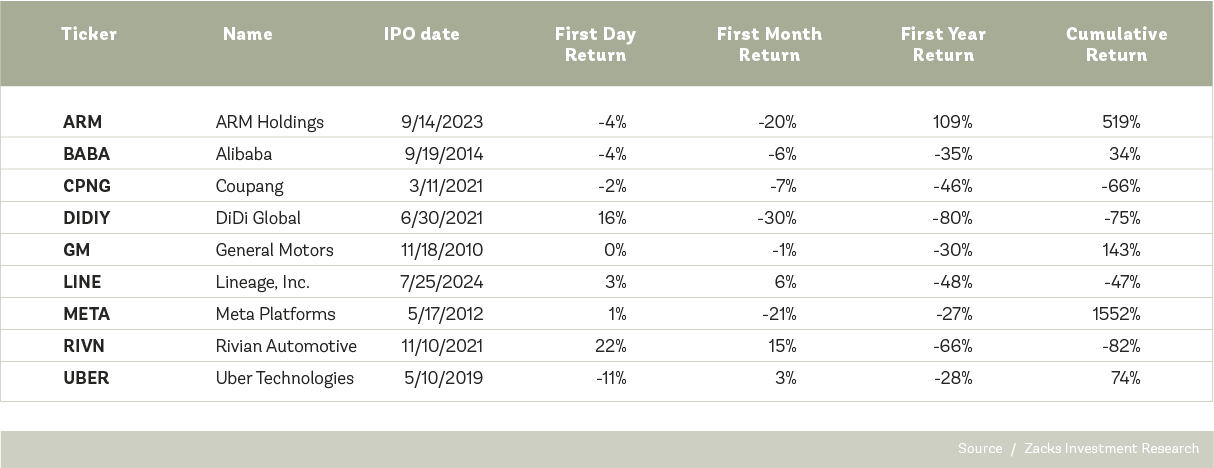
Ritter’s research shows that buying IPOs at the close of the first trading day and holding for three years has underperformed a value-weighted market index by roughly -21% on average. The table below helps illustrate the point. Some of the largest and most widely followed IPOs of recent years performed poorly in their first year of trading. Rivian fell roughly -66% in its first year, Coupang declined about -46%, Alibaba fell about -35%, and Uber dropped about -28%. Even Meta, now one of the great long-term winners of the modern market, was down about -27% in its first year after going public.
Great companies can become great long-term investments, but investors do not necessarily need to buy them immediately after they go public to benefit. If a company truly becomes a durable compounder over many years, there is usually time to evaluate the business, observe public-market behavior, assess valuation, and understand how it fits within a broader portfolio.
The larger takeaway, in my view, is that investors do not need to overthink how any one company, or even a group of high-profile companies, may reshape the market over time. Some of these businesses may become enduring leaders, while others may struggle to justify the expectations built into their early public valuations. Markets absorb new industries, new technologies, and new corporate giants over time. The discipline is not in predicting exactly which companies will define the next era, but in maintaining a portfolio built to participate in growth while managing the risks that come with concentration, valuation, and changing market leadership.
Source:
[i] IPO Data, Jay Ritter, University of Florida
____________
The opinions voiced in this material are for general information only and are not intended to provide specific advice or recommendations for any individual. This material was produced for Judy Rubino’s use. Investing involves risk including loss of principal. No strategy assures success or protects against loss.