
Interest rates have been moving higher across the board. Anyone trying to buy—or for that matter, sell—a house is well aware of the pressure, as mortgage rates have now crossed back over 7%. Auto loans and credit card interest rates are also moving up. Though the Federal Reserve voted to hold rates steady at their latest meeting, the moves have been fairly substantial. Here’s a quick breakdown:
The benchmark fed funds rate, set by the Federal Reserve, was increased by 25 basis points to a range of 3.75% to 4.00%. They are widely expected to raise rates again in December.
The 10-year U.S. Treasury bond has gone from approximately 4.20% to 4.90% (as of this writing) this year.
The 30-year U.S. Treasury bond moved from approximately 4.86% to 5.27%.
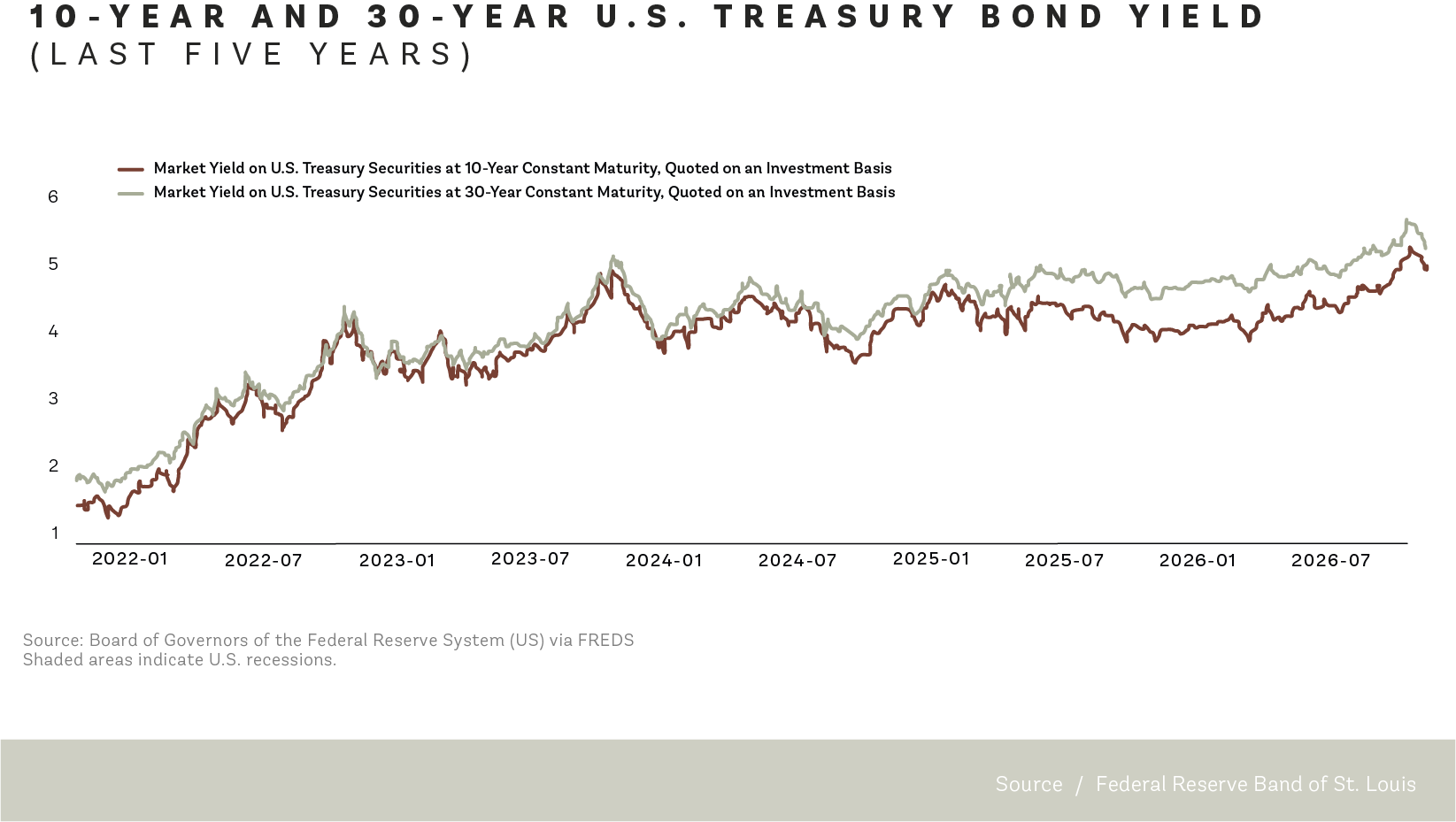
There has been a lot of debate over why interest rates have moved sharply higher this year. We tend to view interest rate moves as tied to four potential factors:
Rising inflation and the expectation of higher inflation in the future.
Strong economic growth and the expectation for more strong growth in the future.
The expectation of tighter monetary policy, which is linked to expectations for strong growth and high inflation.
Rising government deficits and debt, which raises the compensation investors demand in exchange for buying bonds.
From our vantage, all of these forces are relevant today, and we would argue that they’re all contributing to higher interest rates in some form.
So, what does that mean for markets going forward? I think a few things.
First, when there’s an expectation that interest rates are going to be “higher for longer,” the bond market starts competing with stocks for investor capital. If an investor can capture a 5% yield in a 10-year Treasury bond, they may not be as willing to invest in stocks (which have annualized roughly 10% over the long run[1]).[i] The higher interest rates go, the more compelling that trade-off becomes.
In the current context of higher rates, I think it’s important to remember that we are coming off a multi-year period when interest rates were relatively low and corporate earnings were booming, largely tied to the AI theme. The question now is what happens if rates keep moving higher while corporate profits grow more slowly from here?
I do not think the answer is ‘a down market.’ But it could mean we are entering a more mature phase of the bull market, with further gains coming at a more moderate pace. From an investor’s perspective, maybe that means the strong double-digit gains of previous years may temper in future years of this bull market.
The keys, as ever, are economic growth and corporate earnings growth, both of which remain quite strong today. In the second quarter, current-dollar GDP increased at an 8.0% annualized rate (real GDP of 1.5%), and real final sales to private domestic purchasers—which is a good indicator of underlying demand in the economy—rose at a 4.2% annualized rate[ii]. As of November 9, the Atlanta Fed GDP Now indicator is showing the U.S. economy grew at a 3.5% annualized rate in the third quarter. This would be very strong growth.
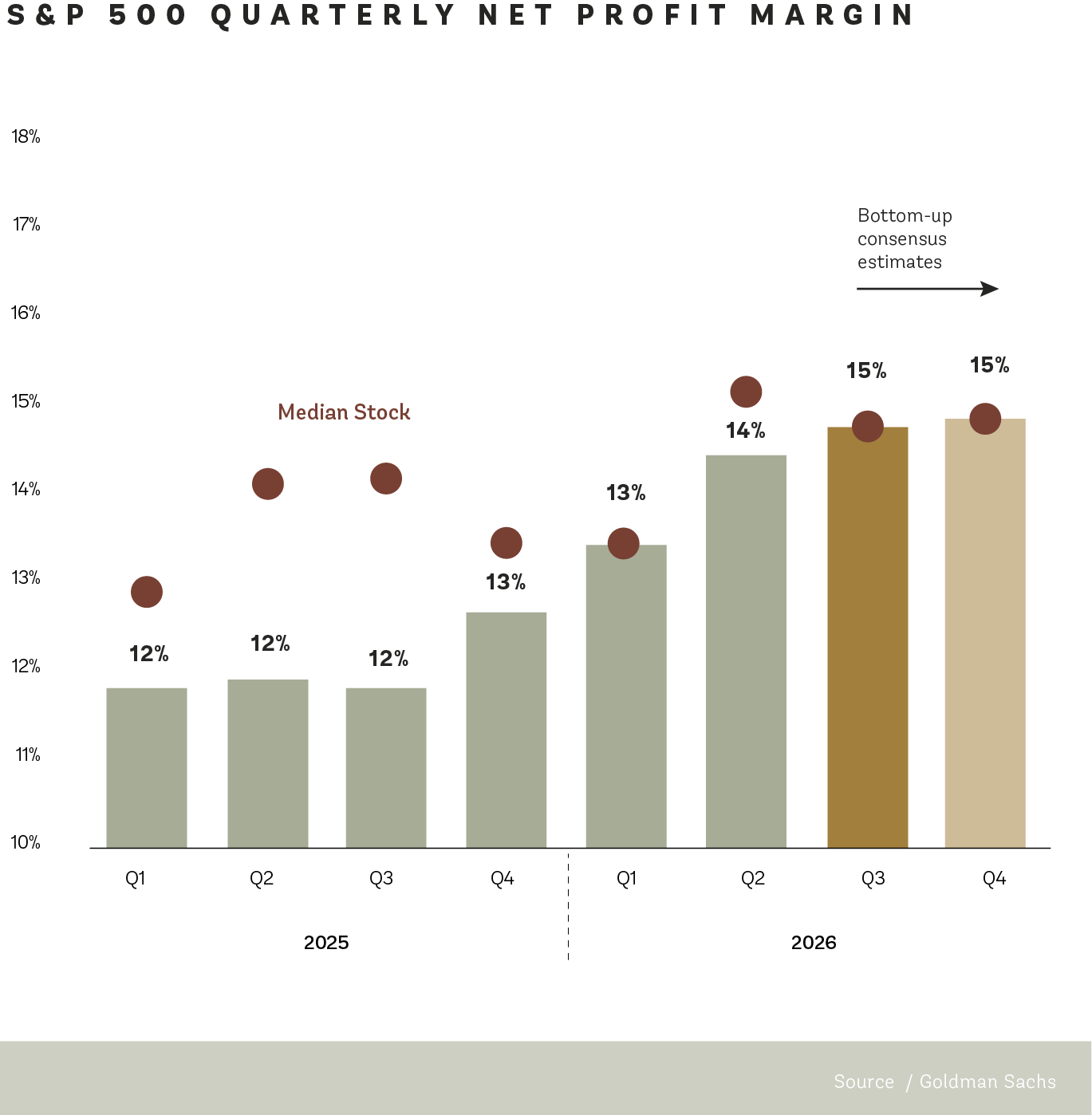
Corporate earnings have also been exceptionally strong. According to FactSet, S&P 500 earnings grew approximately 52% year-over-year in the second quarter, and current estimates point to another 29.5% increase in the third quarter.[iii] Profit margins, as seen on the chart below, also remain very high relative to history. These are both strong supports for the stock market, even in an era of relatively higher rates.
____________
[1] Since 1957, using annualized S&P 500 returns with dividends reinvested.
Questions about AI spending, geopolitics, and AI job displacement can make it harder to feel confident about the outlook. Uncertainty is high. But if the economy keeps expanding and profits keep growing, stocks can continue advancing even if interest rates are at high levels than they were a few years ago. They just may not go up as fast.
Source:
[i] Investopedia, “S&P 500 Average Returns and Historical Performance,” May 2026
[ii] U.S. Bureau of Economic Analysis, “Gross Domestic Product (Second Estimate) and Corporate Profits, 2nd Quarter 2026,” August 26, 2026.
[iii] FactSet, “S&P 500 Earnings Season Update: July 31, 2026,” July 31, 2026.
____________
The opinions voiced in this material are for general information only and are not intended to provide specific advice or recommendations for any individual. This material was produced for Judy Rubino’s use. Investing involves risk including loss of principal. No strategy assures success or protects against loss.